Introduction
Smart TVs have completely changed the way people consume digital entertainment. Instead of relying exclusively on traditional cable or satellite television, viewers can now connect their televisions to the internet and access a wide range of streaming platforms, applications, live television services, and video-on-demand libraries.
This evolution has also made IPTV increasingly popular among people who prefer internet-based television.
TVLIO is a name associated online with IPTV streaming and is commonly searched by users interested in live television, sports, movies, TV series, and video-on-demand entertainment. One of the most important questions for anyone researching TVLIO is whether an IPTV service can be used conveniently on a Smart TV.
The answer depends on several factors, including the television operating system, the IPTV application being used, the provider’s compatibility requirements, and the type of subscription or credentials supplied by the service.
This guide explains how IPTV works on Smart TVs, what users should know about TVLIO compatibility, the differences between Samsung, LG, Android TV, and Google TV, how IPTV players work, how to troubleshoot common streaming problems, and what to consider before choosing an IPTV service.
The objective is not simply to explain how to install an application. Instead, this guide provides a broader understanding of Smart TV IPTV so viewers can make informed decisions about their streaming setup.
What Is IPTV on a Smart TV?
IPTV stands for Internet Protocol Television.
Unlike traditional television systems that rely primarily on satellite, cable, or terrestrial broadcasting, IPTV uses an internet-based network to deliver video content.
When IPTV is used on a Smart TV, the television essentially becomes a connected media platform.
Depending on the service, viewers may be able to access:
- Live television channels
- Sports programming
- Movies
- TV series
- Video on Demand
- News
- Documentaries
- International television
- Catch-up content
- Electronic Program Guides
The exact features depend on the IPTV provider and the application used to access the service.
It is also important to understand that a Smart TV itself does not automatically provide IPTV content.
A Smart TV provides the hardware and operating system needed to run compatible applications. The IPTV provider supplies the content or access credentials, while an IPTV player may provide the interface used to display that content.
This distinction prevents one of the most common misunderstandings surrounding IPTV.
Can TVLIO Be Used on a Smart TV?
TVLIO is associated online with IPTV services, but compatibility can vary depending on the specific service, application, and television platform.
There is no single universal IPTV application that works identically on every Smart TV.
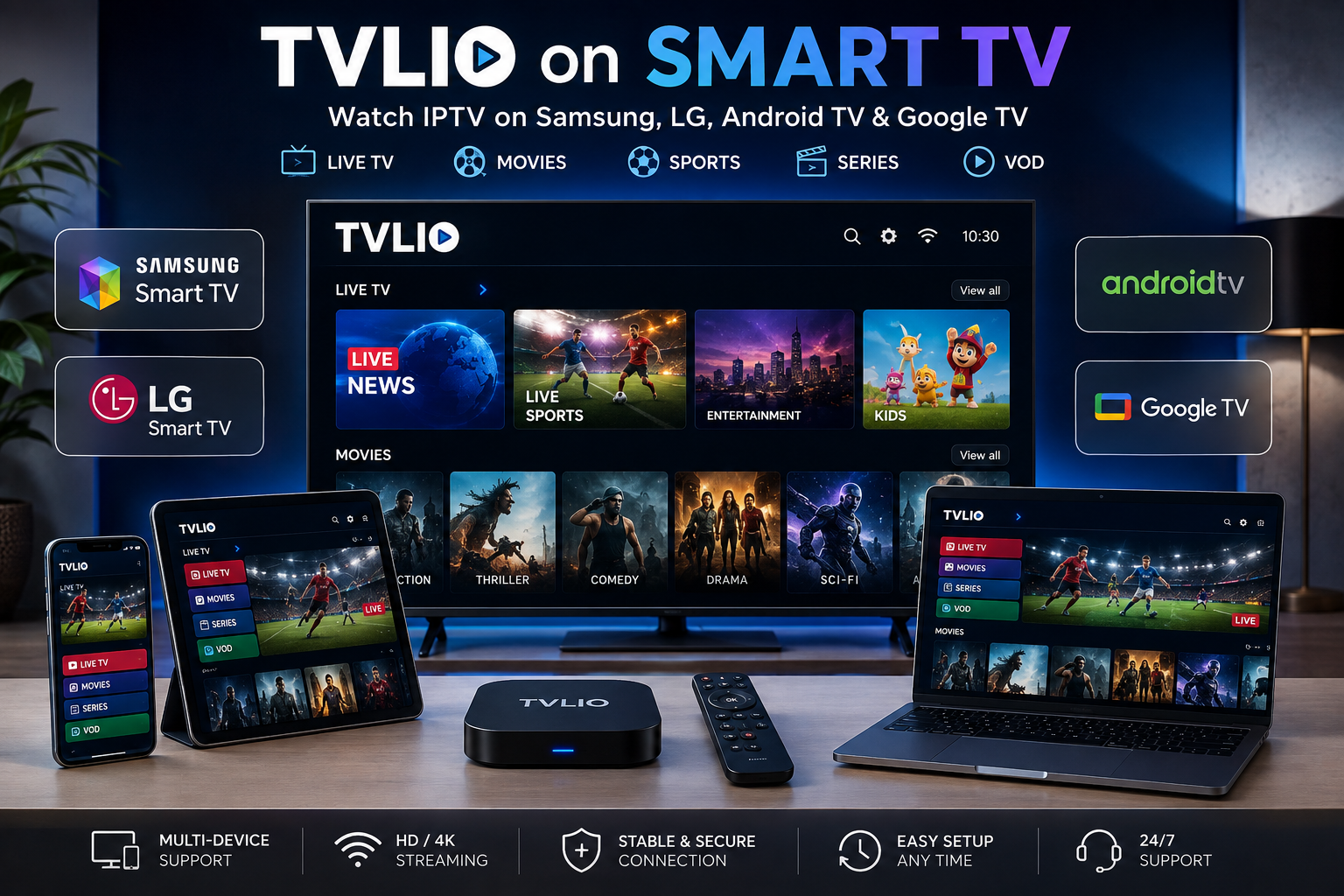
Samsung televisions, LG televisions, Android TV devices, and Google TV products use different software ecosystems. Therefore, the installation process and supported applications can differ.
Before subscribing to any IPTV service, users should verify:
- Their Smart TV model
- Their television operating system
- The IPTV application supported by the provider
- Whether their subscription supports Smart TV playback
- Whether the service provides appropriate setup instructions
- Whether the required IPTV player is available through an official application store
For the latest information about TVLIO and its current service details, users should always verify the current provider information rather than relying on old third-party articles.
TVLIO on Samsung Smart TV
Samsung is one of the most widely used Smart TV platforms.
Samsung Smart TVs generally use the company’s Tizen operating system, which has its own application ecosystem.
This means that installing IPTV on a Samsung television can be different from installing it on Android TV.
Check Your Samsung TV Model
The first step is to determine which Samsung Smart TV model and operating system you have.
Older televisions may have different application availability compared with newer models.
Before attempting to configure IPTV, check the television’s settings and identify the model number.
This is particularly useful when searching for compatible applications or troubleshooting installation issues.
Use the Samsung App Environment
Samsung Smart TVs provide access to applications through the television’s built-in application environment.
Users should look for IPTV applications that are officially available for their particular television.
Application availability can change over time, and not every IPTV player is compatible with every Samsung television.
For this reason, users should not assume that an application available on Android TV will automatically be available on Samsung Tizen.
Why Samsung Compatibility Matters
The operating system determines which applications can run directly on the television.
If an IPTV player is designed specifically for Android TV, it may not have a native Samsung Tizen version.
In that situation, users may need a different compatible player or an external streaming device.
This is one reason device compatibility should be checked before purchasing an IPTV subscription.
TVLIO on LG Smart TV
LG Smart TVs use the webOS platform.
Like Samsung, LG has its own application ecosystem.
The IPTV experience therefore depends on which IPTV applications are available for the television and whether the chosen service supports them.
Checking IPTV Applications on LG
Users can open the LG application environment and search for compatible IPTV players.
The exact applications available may depend on the television model, webOS version, location, and application developer.
If a preferred IPTV player is unavailable, an alternative compatible application may be required.
Why webOS Is Different
One common mistake is assuming that every Smart TV is essentially the same.
Although many modern televisions provide similar streaming capabilities, their operating systems can be very different.
Samsung Tizen, LG webOS, Android TV, and Google TV each have different application ecosystems.
Therefore, an IPTV service that works easily on one television may require a different setup on another.
TVLIO on Android TV
Android TV is one of the most flexible environments for IPTV.
Android TV provides access to a large application ecosystem and supports many streaming applications and IPTV players.
Devices based on Android TV can include televisions and external streaming boxes.
The exact application options depend on the device and region.
One advantage of Android TV is that users can generally find a wider selection of media applications than on some proprietary Smart TV platforms.
However, users should still prioritize applications from trusted sources.
The official Android ecosystem provides information about supported applications and device compatibility.
Android TV information from Google
TVLIO on Google TV
Google TV is closely related to Android TV but provides a more personalized content discovery experience.
Google TV devices can run compatible Android applications, which means IPTV users may have access to a range of IPTV players.
The setup normally involves:
- Connecting the Google TV device to the internet.
- Opening the application store.
- Searching for a compatible IPTV player.
- Installing the application.
- Entering the credentials or playlist information supplied by the legitimate IPTV provider.
- Configuring the application according to the provider’s instructions.
The precise process can vary depending on the application.
Users should also remember that an IPTV player does not necessarily provide television content by itself.
IPTV Player vs IPTV Provider
This distinction is extremely important.
An IPTV provider and an IPTV player are two different things.
IPTV Provider
The provider is the service that supplies access to television streams or video content.
Depending on the service, it may offer live channels, VOD, sports, movies, series, or other programming.
IPTV Player
The player is an application used to display compatible IPTV streams.
A player may support formats or credentials such as:
- M3U playlists
- Xtream-style credentials
- Portal-based configurations
- Other supported streaming formats
However, the player itself may not own or supply the content.
For example, some IPTV applications explicitly describe themselves as players and require users to provide their own subscription.
This means that downloading an IPTV player does not automatically mean that the user has purchased an IPTV service.
Understanding this difference can help users avoid paying twice for services they do not actually need.
What Do You Need to Watch IPTV on a Smart TV?
The basic requirements are relatively straightforward.
1. Compatible Smart TV
The television needs to support the application or method being used.
2. Internet Connection
IPTV depends on internet connectivity.
A stable broadband connection is generally more important than simply having a high advertised download speed.
3. IPTV Subscription
If the chosen provider requires a subscription, the user needs valid access credentials.
The subscription should come from a provider that is transparent about its service and content rights.
4. Compatible IPTV Player
The player must support the format supplied by the provider.
5. Appropriate Network Setup
A reliable Wi-Fi connection can be sufficient, but Ethernet may provide greater stability when the television or streaming device is close enough to the router.
How Internet Quality Affects IPTV
One of the biggest factors affecting IPTV performance is the internet connection.
When a Smart TV receives a video stream, data must continuously travel between the streaming infrastructure and the viewer’s device.
If the connection becomes unstable, the player may not receive enough data to maintain uninterrupted playback.
This can result in:
- Buffering
- Freezing
- Lower picture quality
- Delayed playback
- Disconnections
However, internet speed is only one part of the equation.
Other factors include:
Latency
Latency measures the time required for data to travel between systems.
High latency can affect certain internet applications and may contribute to a less responsive experience.
Packet Loss
If packets of information are lost during transmission, streaming performance can suffer.
Wi-Fi Interference
Walls, distance, congestion, and interference from other wireless networks can affect Wi-Fi performance.
Network Congestion
A household with several devices simultaneously downloading large files, playing online games, or streaming high-resolution video can place additional demand on the network.
Server Performance
Even if the user’s internet connection is excellent, problems on the provider’s side can cause buffering.
This is why IPTV reliability depends on both the viewer’s network and the provider’s infrastructure.
Ethernet vs Wi-Fi for Smart TV IPTV
Both Ethernet and Wi-Fi can be used for internet television.
Wi-Fi is convenient because there is no physical network cable connecting the television to the router.
However, wireless performance can vary depending on distance and interference.
Ethernet provides a direct wired connection and can be useful for televisions or streaming devices located near the router.
For users experiencing unexplained buffering, testing the connection through Ethernet can help determine whether Wi-Fi is part of the problem.
If IPTV works consistently over Ethernet but struggles over Wi-Fi, the issue may be related to the wireless network rather than the IPTV application itself.
What Resolution Can IPTV Support?
Modern IPTV services may advertise different video resolutions.
Common examples include:
- SD
- HD
- Full HD
- 4K
However, users should understand that an IPTV provider advertising 4K does not necessarily mean every channel or movie is available in native 4K.
Actual resolution can depend on:
- Original source quality
- Encoding
- Provider infrastructure
- Available bandwidth
- Device capabilities
- Application support
- Individual channel feeds
A low-resolution source cannot become genuine high-resolution content simply because the television supports 4K.
The Smart TV must also support the relevant resolution and video format.
TVLIO and 4K Streaming
4K has become an important feature in modern television.
However, users should approach 4K claims carefully.
There is a difference between:
A television that supports 4K
and
A specific stream that is delivered in genuine 4K.
The first is a hardware capability.
The second depends on the source and streaming service.
If a provider advertises 4K channels, viewers should look for information about which content is actually available in that resolution.
This is another example of why users should evaluate IPTV services based on more than marketing claims.
Electronic Program Guide on Smart TV
An Electronic Program Guide, commonly known as an EPG, is one of the most useful features of an IPTV platform.
An EPG displays information about television programming.
Depending on the provider and player, an EPG can show:
- Current programs
- Upcoming programs
- Program descriptions
- Channel schedules
- Categories
- Start and end times
A well-designed EPG can make an IPTV application feel more similar to a traditional television service.
However, EPG information depends on the data supplied to the application.
If a provider does not supply accurate program information, the EPG may be incomplete or outdated.
VOD on a Smart TV
Video on Demand is another major advantage associated with modern internet television.
Instead of watching a program according to a fixed schedule, viewers can select available content from a library.
VOD categories can include:
- Movies
- TV series
- Documentaries
- Family entertainment
- Children’s content
- International programming
The exact catalog depends on the provider and licensing arrangements.
Users should also remember that VOD libraries can change.
A title that is available today may no longer be available later because distribution rights can expire or change.
Sports Streaming on Smart TV
Sports are often one of the most heavily marketed categories within IPTV.
A Smart TV provides an ideal large-screen environment for watching live sports.
However, sports broadcasting rights are frequently subject to geographic restrictions and licensing agreements.
Therefore, users should not assume that an IPTV provider has legal authorization simply because it advertises access to a particular sports event.
When evaluating a service, it is better to look for transparent information about content rights rather than relying solely on a large list of available channels.
This is especially important for premium sports programming.
Troubleshooting IPTV Buffering on Smart TV
Buffering is one of the most common IPTV complaints.
Fortunately, there are several areas users can check.
Restart the Router
A simple router restart can sometimes resolve temporary network problems.
Restart the Smart TV
Restarting the television can clear temporary application or system issues.
Test Another Application
If other streaming services also buffer, the problem may be related to the internet connection.
If only one IPTV service experiences problems, the issue may be related to the application or streaming provider.
Check Wi-Fi Signal
If the television is far from the router, wireless performance may be weaker.
Try Ethernet
If possible, connect the television or streaming device through Ethernet.
Check Server-Side Issues
If multiple users are experiencing interruptions, the problem may be associated with the provider’s streaming infrastructure.
IPTV Application Not Working on Smart TV
Sometimes an IPTV application may fail to open or operate correctly.
Potential causes include:
- Outdated application
- Unsupported TV model
- Outdated television software
- Application compatibility problems
- Network connectivity issues
- Temporary service problems
The first step should be identifying whether the problem occurs with the application itself or with the IPTV service.
Updating the television software and application can help when an official update is available.
Users should avoid downloading modified applications from unknown websites simply because an application is unavailable through the television’s official store.
Why Smart TV Operating Systems Matter
The operating system is one of the most important compatibility factors.
A Samsung television may use Tizen.
An LG television may use webOS.
Android TV uses Google’s Android-based television environment.
Google TV builds on the Android TV platform with an updated interface and content discovery experience.
Because these systems differ, the IPTV setup can also differ.
This is why a good IPTV provider should clearly explain which devices and applications it supports.
Is a Smart TV Better Than a Streaming Box for IPTV?
There is no universal answer.
A Smart TV is convenient because the hardware is already integrated into the television.
Users may not need another device.
However, a separate streaming device can provide additional flexibility.
For example, if a television’s operating system does not support the preferred IPTV player, an external Android TV or Google TV device may provide another option.
A streaming box can also be replaced without replacing the television itself.
The best choice depends on the user’s equipment, application requirements, network setup, and preferred interface.
How to Choose an IPTV Provider for Smart TV
Device compatibility should be only one part of the decision.
Before subscribing, consider the following factors.
Transparent Pricing
The provider should clearly explain its subscription price and what is included.
Device Compatibility
Check whether your specific Smart TV platform is supported.
Content Rights
A responsible provider should be able to explain the legitimacy of the content it distributes.
Customer Support
Reliable customer support can be important when setting up a new service.
Refund Policy
Read the actual refund terms rather than relying only on promotional language.
Privacy
Check how personal information is handled.
Payment Security
Use a payment process that provides appropriate security protections.
Service Reliability
Look for evidence of consistent service rather than focusing only on channel counts.
TVLIO Safety Considerations
Users should take basic security precautions when researching or subscribing to any online television service.
Do not install applications from suspicious websites simply because they promise additional features.
Be careful with applications requesting permissions unrelated to their purpose.
When entering personal or payment information, verify that you are using the correct website and a secure payment process.
Users should also distinguish between automated website security reports and comprehensive verification.
A security scanner may identify technical characteristics of a website, but that does not automatically prove that the business is legitimate, licensed, or reliable.
The same principle applies in reverse: the absence of an obvious technical security warning does not independently prove that a provider has appropriate content rights.
Legal Considerations for IPTV on Smart TV
IPTV technology itself is not illegal.
Internet-based television is widely used by legitimate broadcasters, telecommunications companies, streaming platforms, and television operators.
The important issue is the content being distributed.
A provider needs appropriate authorization or licensing for copyrighted television channels, movies, sports events, and other protected content where required.
Therefore, users should evaluate the provider rather than the IPTV technology itself.
If a service offers premium content at unusually low prices but provides no meaningful information about licensing or business identity, additional research is appropriate.
Common Mistakes When Setting Up IPTV on Smart TV
Several mistakes occur repeatedly.
Mistake 1: Assuming Every IPTV Player Is a Provider
A player may only be software.
Mistake 2: Installing Unofficial Applications
Unknown applications can create unnecessary security risks.
Mistake 3: Focusing Only on Channel Numbers
A large channel count does not guarantee quality or legitimacy.
Mistake 4: Ignoring the Television Operating System
Samsung, LG, Android TV, and Google TV can require different applications.
Mistake 5: Assuming 4K Means Every Channel Is 4K
Resolution varies by source.
Mistake 6: Blaming the Internet for Every Buffering Problem
Server-side issues can also cause interruptions.
Mistake 7: Paying Before Checking Compatibility
Always confirm that the service works with your device before committing to a long-term plan.
How to Improve Your Smart TV IPTV Experience
Once a legitimate and compatible IPTV service has been selected, several practical steps can improve the viewing experience.
Keep Your Smart TV Updated
Install official system updates when they become available.
Keep Applications Updated
An updated IPTV player may contain compatibility improvements and bug fixes.
Use a Reliable Router
Older or poorly positioned routers can affect streaming performance.
Reduce Network Congestion
If several devices are consuming large amounts of bandwidth, IPTV performance may be affected.
Consider Ethernet
A wired connection can be useful when Wi-Fi is unstable.
Avoid Untrusted Software
Use official application stores or reputable sources whenever possible.
TVLIO Smart TV Setup Checklist
Before attempting to use TVLIO or another IPTV service on a Smart TV, use this checklist:
Device
Check the television model and operating system.
Internet
Confirm that the television has a stable internet connection.
Application
Verify which IPTV player is compatible with the device.
Subscription
Confirm that the IPTV provider supplies valid access credentials.
Compatibility
Make sure the provider supports your particular platform.
Security
Use trusted applications and secure payment methods.
Licensing
Look for meaningful information about content rights.
Support
Check whether the provider offers a clear way to obtain technical assistance.
Terms
Read subscription, refund, privacy, and cancellation policies before paying.
Frequently Asked Questions
Can I watch IPTV on a Smart TV?
Yes. IPTV can be accessed on many Smart TVs through compatible applications or supported external streaming devices.
Does every Smart TV support the same IPTV applications?
No. Samsung, LG, Android TV, and Google TV use different software ecosystems, so application availability can vary.
Can TVLIO work on Samsung Smart TV?
Compatibility depends on the current TVLIO service, supported IPTV application, Samsung model, and operating system. Users should verify current compatibility before subscribing.
Can TVLIO work on LG Smart TV?
It may be possible through a compatible IPTV application, but compatibility depends on the current service and LG webOS environment.
Is Android TV good for IPTV?
Android TV is a popular platform for IPTV because it supports a broad range of applications and streaming tools.
What is the difference between IPTV and a Smart TV?
A Smart TV is a television with an internet-connected operating system. IPTV is a method of delivering television content over an IP network.
Do I need an IPTV player?
If the provider requires a compatible IPTV application, then yes. The exact player depends on the service and device.
Does an IPTV player provide channels?
Not necessarily. Many IPTV players are simply software applications that display content supplied by a separate provider.
Why does IPTV buffer?
Buffering can result from Wi-Fi problems, network congestion, latency, packet loss, insufficient bandwidth, server-side problems, or issues with the stream itself.
Is Ethernet better than Wi-Fi for IPTV?
Ethernet can provide a more consistent connection when available, but a well-configured Wi-Fi network can also work effectively.
Can IPTV support 4K?
Yes, IPTV technology can support 4K streaming, but actual 4K availability depends on the source, provider, application, device, and network.
Does IPTV require satellite?
No. IPTV uses an IP network and does not inherently require a satellite dish.
Final Thoughts
Using IPTV on a Smart TV can provide a flexible way to access internet-based television, live programming, movies, series, sports, and video-on-demand content.
TVLIO is a name associated online with this IPTV market, but the exact compatibility and service details can change over time. Therefore, users should verify current information before purchasing a subscription.
The most important factor is not simply whether a television is marketed as a Smart TV.
The operating system matters.
Samsung Tizen, LG webOS, Android TV, and Google TV each have different application ecosystems and compatibility requirements. An IPTV application available on one platform may not be available on another.
Users should also understand the difference between an IPTV provider and an IPTV player. The provider supplies access to content, while the player is the software used to display compatible streams.
Streaming quality is similarly dependent on multiple factors. A modern television may support 4K, but that does not mean every IPTV channel is delivered in native 4K. Internet stability, server performance, encoding, source quality, and device capabilities all influence the final viewing experience.
Security and legality are equally important.
IPTV technology itself is a legitimate internet-based delivery method. The key question is whether a particular provider has appropriate rights to distribute the content it offers.
For this reason, users should examine licensing information, business identity, pricing transparency, privacy policies, refund conditions, payment security, customer support, and device compatibility before subscribing.
Ultimately, the best Smart TV IPTV setup is not necessarily the one with the largest advertised channel list. A better approach is to choose a service that is transparent, compatible with your equipment, technically reliable, secure, and appropriately licensed.
By understanding how IPTV works and how Smart TV platforms differ, viewers can make better decisions and create a smoother internet television experience.